Experiments
12 Days In: What It Really Takes to Build an Online Business From Scratch
29 October 2026 · 11 min read
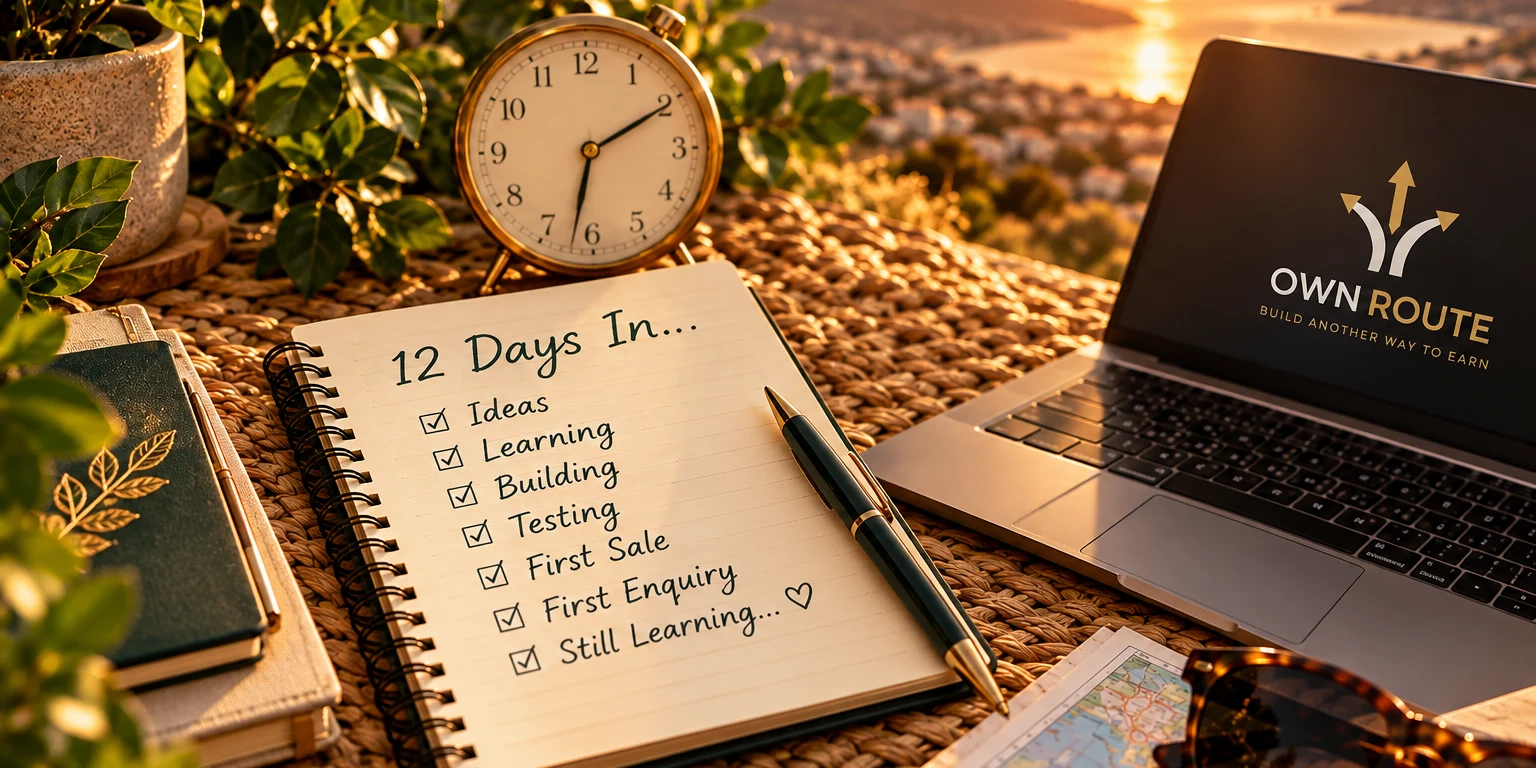
Experiment 001 · 29 October 2026
Real Experiments. Real Numbers. Real Lessons.
When you see someone launching an online business, it's easy to imagine them buying a product, setting up a website, posting a few things on social media and waiting for the sales to start.
I wish it were that simple! 😂
On 16 October 2026, I joined Legacy Builders and began building Own Route.
By 28 October, just 12 days had passed.
And when I look at everything I've done during those 12 days, I realise something important:
Starting an online business might be accessible, but that doesn't mean building one requires no work.
I wanted to document exactly what those first 12 days have looked like, because I believe the work behind the scenes matters just as much as the milestones.
Day 1: Making the Decision
On 16 October, I committed to learning something new.
I already had experience running a business, managing projects, leading teams and working in corporate environments. But building a digital business, with the technology, marketing and online sales systems involved, was unfamiliar territory.
I wasn't starting with unlimited money, an established online audience or years of digital marketing experience.
I was starting with a decision, a willingness to learn and a determination to see what was possible.
And then the real work began.
The Part Nobody Sees: Building the Foundations
Before I could even think seriously about attracting customers, I wanted to create a platform that reflected my own vision.
That meant working on the foundations of Own Route.
Over the following days, I worked on:
- Registering my domain, ownroutes.com.
- Setting up my professional email address.
- Developing the Own Route brand, messaging and website.
- Building and testing website functionality, including forms and a database.
- Creating an administration dashboard.
- Setting up my Systeme.io funnels and sales pages.
- Setting up and testing payment functionality in my funnels.
- Organising the digital products and training options.
- Testing the different parts of the customer journey.
Some tasks were straightforward.
Others involved troubleshooting, changing settings, learning terminology I'd never used before and figuring out why something that should have worked simply didn't.
There were moments when I felt incredibly productive, and others when I spent ages trying to solve one small problem.
That's something I want people to understand.
A website might look simple when it's finished. The process of getting it there isn't always simple.
And although I use AI tools to help me learn, build and solve problems, I still need to make decisions, check the results, test functionality and understand what I'm putting together.
AI can make certain tasks easier. It doesn't remove the responsibility of building a working business.
But Here's Something Important: I Chose to Build More
I want to clarify something because I believe in being completely transparent about this journey.
Legacy Builders already provides a pre-built system designed to help members get started without having to create everything from scratch.
The programme includes training and an existing online business setup, which can significantly reduce the technical work involved in getting started.
So why have I spent so much time building websites, setting up systems, developing a brand and creating content?
Because I made a conscious decision that I wanted Own Route to become something bigger than just Legacy Builders.
I didn't want to build a business that revolved around promoting one programme or one set of digital products.
I wanted to create my own brand. My own platform. My own space where I could explore different digital income opportunities, share my experiences, develop resources and eventually introduce additional products and services.
Legacy Builders is part of my journey, but it isn't the entire vision for Own Route.
That's why I decided to build my own website, create the Own Route Journal, develop my own digital infrastructure and establish a brand that could grow and evolve independently.
And yes, that decision has meant considerably more work!
There have been hours spent learning technical skills, troubleshooting systems, making design decisions and figuring things out that I wouldn't necessarily have needed to do if I'd simply followed the existing setup.
But that extra work was my choice, not a requirement of joining Legacy Builders.
I think that's an important distinction for anyone following my journey.
If your goal is to get started using the system already provided, your setup process could look very different from mine.
If your goal is to build a broader digital business around your own brand, you may choose to invest additional time developing your own systems, just as I have.
Neither approach automatically guarantees success.
For me, Own Route is a long-term vision.
I'm not just learning how to sell a digital product.
I'm learning how to build a digital business that I can continue developing, expanding and making my own.
And that's why these first 12 days have been so busy.
Then Came the Marketing
Once I had the foundations taking shape, I needed to start building an audience.
On 18 October, I began growing Own Route's presence on Facebook, Instagram and LinkedIn.
I started with zero followers.
I didn't have an advertising budget to throw at the problem, so I began with what I already had: my personal connections, my own social media profiles and a willingness to show up consistently.
I shared posts, told people about Own Route, engaged with other businesses and began documenting the journey.
On 27 October, I also launched Own Route on TikTok.
Recording my first video was an experience all on its own!
I wasn't comfortable, it wasn't perfectly edited and I certainly didn't feel like a polished content creator.
But I posted it anyway.
Because if I wait until I'm completely comfortable with everything, I might never start.
My Audience After the First Few Days
By 27 October, my social media accounts had reached:
| Platform | Followers |
|---|---|
| 38 | |
| 3 | |
| 8 | |
| TikTok | 4 |
| Total platform follows | 53 |
Those are not 53 confirmed customers or necessarily 53 different people.
They're 53 platform follows.
But considering that I started at zero, with no paid advertising, they represent genuine early progress.
I Also Started Writing About the Journey
One of the things I decided early on was that I didn't want Own Route to become another website filled with big promises and success stories that leave out the difficult parts.
I wanted to show the actual process.
So I started the Own Route Journal.
By 28 October, I'd published five entries covering my decision to start, the costs involved, my first sale and my earliest social media results.
Writing these articles takes time too.
There's the thinking, the planning, the writing, choosing visuals, checking the details and publishing everything.
But I believe it's worth doing.
Even if Own Route takes longer to grow than I hope, I'll have an honest record of what I tried, what worked and what didn't.
My First Sale — But Let's Keep It in Perspective
On 24 October, I made my first $100 digital product sale.
That was a significant moment for me.
The actual amount received in my bank account was R1,657.37.
The payment was made by EFT, without an additional processing fee.
But there's an important distinction.
That sale came through an existing personal contact, not through my new social media audience.
It was also gross sales revenue, not profit.
I had already invested money in getting started, and there are still business costs to account for.
I'm sharing this because I don't want to create the impression that opening social media accounts automatically generated a sale.
It didn't.
My first sale was encouraging, but it wasn't proof that I'd built a predictable income stream.
So, How Much Time Has This Actually Taken?
This is probably the most important question.
When people talk about starting an online business, they often focus on how little money you might need or how flexible it could become.
But what about the time?
In my first 12 days, I've been learning new platforms, building a website, configuring systems, testing processes, developing content, creating social media profiles, writing articles and responding to the challenges that come with starting something new.
I haven't kept an accurate hour-by-hour timesheet, so I'm not going to invent a number.
What I can say is that it has involved a substantial amount of hands-on effort, especially during the initial setup.
But there's something I need to emphasise again.
Much of that time was spent building the additional Own Route infrastructure that I personally chose to create.
If I had simply used the pre-built Legacy Builders system, my setup process would have looked very different.
I chose to take the longer route because I wanted to create a business that could eventually support more than one product, programme or income opportunity.
That doesn't make my approach better than someone else's.
It simply means my goals are different.
And I'm still learning.
I hope that as my systems become more established, some routine tasks will require less of my time.
But getting to that point requires work upfront.
Flexibility is something I'm trying to build towards. It isn't something I automatically received the day I joined.
And Then Life Happened
On 28 October, I wasn't feeling well.
I had an upset tummy, felt nauseous and low on energy and needed to rest.
Normally, as a business owner, taking time away from work can be frustrating because there's always something that needs doing. And if you are full time employed you need to apply for sick leave.
But this time, I noticed a small difference.
My website was still available.
My existing content could still be read.
I had the ability to schedule social media posts rather than needing to publish everything manually at the exact moment.
It didn't mean the business was suddenly making money without me.
It meant that some of the foundations I'd been working on were beginning to give me flexibility.
And on a day when I genuinely needed to rest, I appreciated that.
I'm not building a business where I never have to work. I'm building one where I can work more intentionally.
What Have I Actually Achieved in 12 Days?
When I look back at where I started, I can see real progress.
I have a brand, a website, digital sales infrastructure, a growing journal and a presence across four social media platforms.
I've made my first $100 sale.
I've started learning practical digital marketing skills.
I've made mistakes, solved problems, tried unfamiliar things and pushed myself outside my comfort zone.
What I don't have yet is a large audience, consistent online enquiries, predictable monthly revenue or proof that this business model will deliver the results I'm working towards.
And that's okay.
Because this is still the beginning.
Update: 29 October — My First Online Enquiry!
I was preparing to reflect on my first 12 days when something exciting happened this morning.
I received my first inbound enquiry through Facebook Messenger!
Someone reached out to ask what the opportunity entails.
This is separate from my progress figures through 28 October, but I wanted to record it because it's a meaningful milestone.
For the first time, someone has contacted me through my new online presence to find out more.
It's an enquiry, not a sale.
I don't know whether it will turn into anything further.
But it shows that someone is interested enough to start a conversation.
And for a business that only began building its online audience on 18 October, that's encouraging.
The Lesson I'm Taking Forward
If there's one thing these first 12 days have taught me, it's that building an online business isn't necessarily about finding an easier way to work.
It's about learning how to build something differently.
There are tools that can automate processes.
There are systems that can operate when you're offline.
There are opportunities to learn skills and reach people beyond your immediate geographical area.
But none of those things guarantees success.
They still require learning, effort, testing, consistency and patience.
And I've also learned that there's a difference between getting started with an existing business system and choosing to build an independent brand around a bigger vision.
Legacy Builders provides a system to help me get started. Own Route is the business I'm choosing to build around my own long-term goals.
I'm proud of what I've managed to build so far.
I'm also very aware of how much I still need to learn.
And that's exactly why I'm documenting this journey.
Not because I've figured it all out.
But because I'm willing to find out what it really takes.
Until the next experiment,
Yolandi
Founder, Own Route
Build Another Way to Earn.
Transparency note: This journal documents my personal experience, not a promise of earnings or results. The $100 sale is gross revenue, and the audience figures represent platform follows rather than verified unique individuals. Results will vary depending on circumstances, effort, skills, costs and other factors.
Read our full Reseller Disclosure.